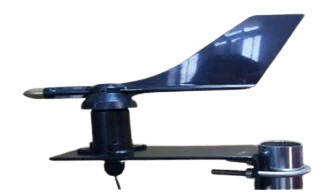
A Wind Direction Sensor is also known as a wind vane sensor. It’s a precision instrument that’s designed to measure the direction from which the wind is exactly blowing. This sensor generally uses a rotating vane connected to a potentiometer, or sometimes an encoder that converts wind movement into electrical signals. These signals are then processed and displayed through a wind monitoring system. Such sensors actually play a crucial role in meteorological equipment, solar tracking systems, and industrial automation, where accurate wind data is really important for safety, performance and energy optimization. By integrating a reliable wind direction sensor, organizations can improve forecasting accuracy, enhance system efficiency, and ensure stable operation in weather-dependent applications like wind farms, airports, and research stations.
Download Technical DatasheetA wind direction sensor works on a simple yet effective working principle that actually converts the movement of air into readable data. Here’s how exactly it functions:
This sensor has a wind vane that freely rotates according to the direction of the wind.
As the vane moves, it changes the position of an internal potentiometer that actually detects the exact angular position.
This angular movement is then converted into a voltage signal (usually 0–5V), which corresponds to the wind direction.
The generated signal can be easily transmitted to data loggers, solar monitoring systems, or IoT-based environmental setups for analysis.
The output can be connected to the data logger, solar monitoring systems, along with environmental monitoring setups for real-time analysis.
This mechanism truly makes it reliable for meteorological, industrial, and renewable energy monitoring applications.
| Wind Direction Sensor — Technical Specifications | |
|---|---|
| Sensor Type | Wind vane potentiometer type |
| Material | Control Head: UV-resistant ABS |
| Wind Vane | Polycarbonate |
| Range | 0–360° |
| Accuracy | ± 3° |
| Output | 0–5 V |
| Supply | 12–24 V DC |
| Cable Length | 2 meters |
| Operating Temperature | −40 to 75 °C |
| Colour Code | Brown: Supply | Black: GND | Blue: Output |
A wind direction sensor works on a simple yet effective working principle that actually converts the movement of air into readable data. Here’s how exactly it functions:
The Logics PowerAMR’s wind direction sensors precisely deliver highly accurate data across varying wind speeds and directions. It’s actually designed to provide steady and real-time readings that are essential for environmental studies, solar monitoring, and industrial automation.
It is built from UV-resistant ABS and polycarbonate material, and withstands harsh sunlight, heavy rain, and extreme temperatures, and ensures reliable operation year after year without even performance degradation.
These sensors are designed for compatibility with Logic PowerAMR data loggers, wind monitoring systems, along with other meteorological equipment, and allow for easy connectivity and continuous data transmission for analysis and reporting.
Its lightweight, corrosion-resistant body makes installation straightforward. Once mounted, it needs very less maintenance, and it reduces downtime and operational costs.
Delivers 0-5V voltage output along with smooth signal stability, and ensures precise direction tracking even during turbulent weather.
Perfect for solar plants, weather monitoring stations, industrial ventilation systems, and agricultural automation setups where accurate wind data is essential for operational efficiency and safety.
The PowerAMR wind direction sensor delivers precise wind data for a variety of critical applications:
Provides accurate wind direction for forecasting and climate analysis.
Optimizes panel orientation and system performance based on wind conditions.
Enhances turbine efficiency by adjusting to real-time wind direction.
Supports efficient irrigation and pesticide application by monitoring wind patterns.
Tracks pollutant dispersion and wind behavior for studies and monitoring.
Integrates wind data for building management, ventilation, and machinery safety.
Our wind direction sensor is truly especially designed for seamless integration with a wide range of monitoring control systems. Its 0-5 analog output allows easy connection to Logics PowerAMR’s remote monitoring system, third-party controllers, or even data loggers for real-time IoT platforms, and enables centralized monitoring of environmental and renewable energy parameters. This compatibility ensures that wind direction can be efficiently recorded, analyzed, and utilized for automation, performance automation, along with safety applications, and this makes it a versatile choice for meteorological, industrial, and solar energy projects.
Allow sufficient clearance for the wind sensor. Install the wind sensor away from buildings or any other objects that might affect the airflow.
Try to make the sensors the highest object around. 7 feet or more above the surrounding obstructions is best.
The sensor must be mounted in an upright position; otherwise, water can enter the sensor and destroy it.