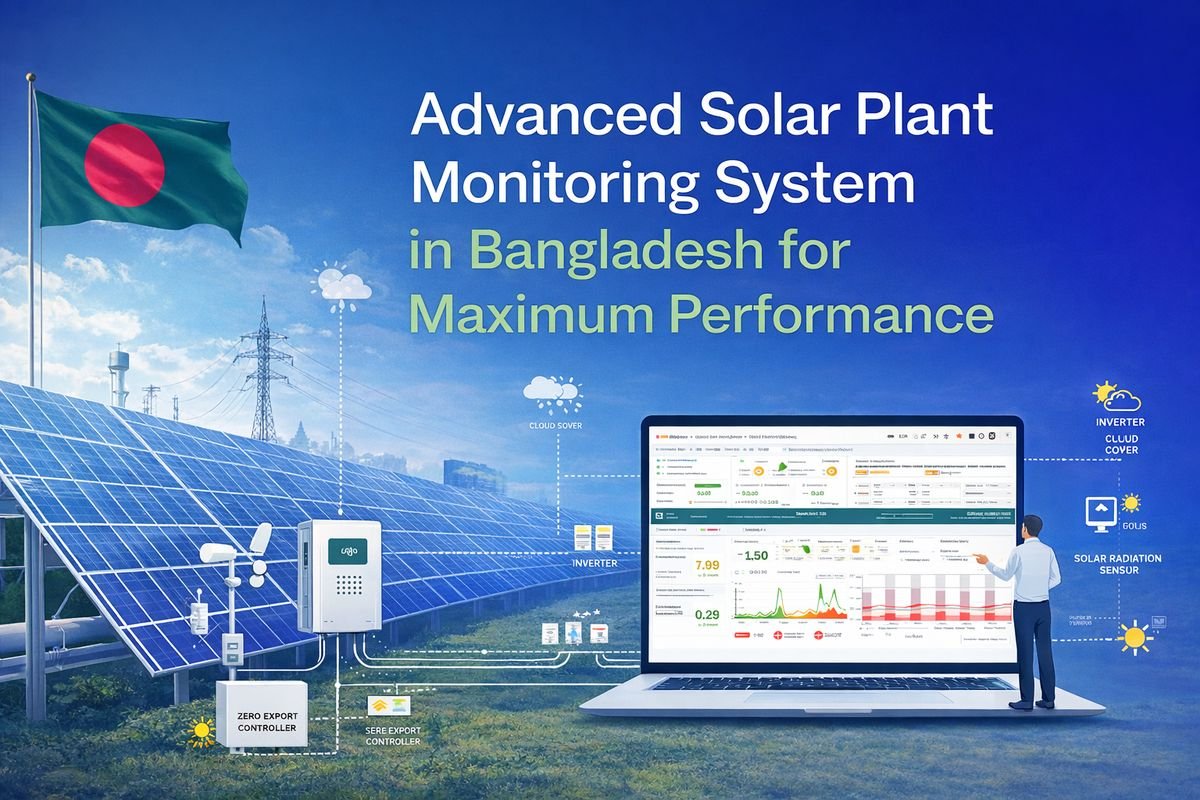
The need for solar power is increasing in Bangladesh due to increasing electricity prices, government support, and sustainability commitments from various industries. But just setting up a solar plant is not sufficient anymore. To achieve maximum efficiency, effectiveness, and profitability, a Solar Plant Monitoring System in Bangladesh is required.
Advanced solar power plant monitoring, solar SCADA, and energy monitoring system solutions have become essential for maximizing solar plant performance, reducing losses, and maintaining grid compliance, especially in the tough power grid of Bangladesh.
Solar Energy Growth & Monitoring Challenges in Bangladesh
Bangladesh is experiencing a dramatic increase in rooftop and ground-mounted solar installations, especially in industrial estates, commercial buildings, and export-oriented manufacturing facilities. But this is also creating a set of distinct monitoring challenges.
Major Challenges in Bangladesh for Solar Energy Monitoring
1. Rapid Adoption of Industrial Rooftop Solar Systems
Industrial rooftops are setting up high-capacity solar systems, but most of these do not have sophisticated solar power plant monitoring systems, resulting in "invisible" losses.
2. Grid Instability & Voltage Fluctuations
Regular grid voltage fluctuations demand smart solar SCADA solutions to avoid inverter shutdowns and export compliance issues.
3. Losses in Performance Because of Inadequate Monitoring
Without module-level or plant-level monitoring, underperforming solar strings and inverters go unnoticed for weeks.
4. Need for a Real-Time Energy Monitoring System
Manual meter readings do not offer any useful information or real-time notifications for errors and down times.
5.Lack of Historical Performance Data
The absence of centralized monitoring platforms makes it impossible to analyze trends and perform predictive maintenance.
6. Pressure to Comply & Report
Industries are now forced to substantiate solar return on investment, solar generation accuracy, and grid performance to the utility company and auditors.
Why Basic Monitoring Is Not Enough for Bangladesh Solar Projects
In Bangladesh, most solar plants are relying on basic inverter-level monitoring, which provides only limited power generation data. Although this helps determine if the solar plant is operational, it does not help understand performance degradation and concealed faults that directly affect the bottom line.
Basic monitoring is not correlated with weather conditions, and therefore, it is not possible to understand the impact of solar irradiance, cloud movement, and temperature on solar power generation. Moreover, it does not identify string-level problems, module degradation, and partial shading, which cause energy losses for a long time without being detected.
Another significant problem is grid instability. Without a solar SCADA system and zero export control, solar plants can potentially export surplus power, causing penalties and non-compliance. Furthermore, inverter-based platforms do not provide centralized visibility, which is necessary for EPC companies managing multiple solar plants.
An advanced Solar Plant Monitoring System in Bangladesh addresses these limitations by integrating real-time solar power plant monitoring, weather analytics, and energy monitoring system intelligence.
Complete Solar Plant Monitoring Solution by Logicspower
Logicspower provides a complete Solar Plant Monitoring System in Bangladesh, which is specifically developed for the Bangladesh grid and climate.
How the Logicspower Monitoring System Works
Step 1: Implementation of Solar SCADA System
A solar SCADA system is implemented to monitor the solar power plant in real-time.The system is integrated with inverters, meters, and sensors.This provides a single-point solution for monitoring the solar power plant.It provides a foundation for performance monitoring and control.
Step 2: Setting Up Solar PV Monitoring Dashboard
A web-based monitoring dashboard is set up to monitor solar power plant performance.The dashboard monitors live solar power generation, energy consumption, and system notifications.The dashboard enables easy detection of system faults and underperformance.It enhances system efficiency and response time.
Step 3: Integration of Inverter Monitoring
Multiple inverter brands are integrated into a single monitoring system.The system eliminates the need for multiple inverter applications.It enhances daily system monitoring and performance comparison.
Step 4: Configuration of Zero Export Controller
The zero export controller dynamically controls solar power plant output according to grid demand.The controller prevents the solar power plant from exporting surplus power to the utility grid.It ensures compliance with the Bangladesh grid code.
Step 5: Remote Monitoring System Access
The monitoring system is accessible via web and mobile devices.Plant owners and EPCs can monitor system performance from anywhere.This leads to faster decision-making and fewer site visits.
Step 6: Data Logging & Performance Analytics
All system data is logged for historical analysis and reporting.Performance trends, losses, and areas of inefficiency are easily identified.This leads to improved ROI analysis and optimization.
Integration of Weather & Performance Analytics
Weather is an important factor in solar power production. Logicspower has incorporated sophisticated weather analytics into its energy monitoring solution for performance evaluation.
How Weather-Based Monitoring Increases Accuracy
Step 1: Installation of Pyranometer & Irradiation Sensor
Real-time measurement of solar irradiation to determine the expected solar power output.
Step 2: Integration of Solar Radiation Sensor
Accurate measurement of radiation intensity for PR and loss analysis.
Step 3: Cloud Cover Monitoring
Detection of solar power output reduction due to temporary cloud movement.
Step 4: Deployment of Ambient Temperature Sensor
Monitoring of the effect of ambient temperature on inverter efficiency.
Step 5: Setup of Module Temperature Sensor
Detection of overheated solar modules, which decrease their output and lifespan.
Step 6: Integration of Automatic Weather Station
Integration of wind, humidity, rainfall, and temperature information into the solar SCADA system.
Benefits for Bangladesh EPCs & Developers
An advanced solar plant monitoring system assists EPCs in minimizing down times by identifying issues in real time. Real-time notifications enable quicker action and resolution of problems. This ensures seamless monitoring of solar power plants and reliable energy output.
By incorporating solar SCADA and weather analysis, solar power plant owners can enhance overall energy generation. Efficiency losses due to shading, temperature, or other technical problems are rapidly detected. This results in enhanced efficiency and optimal plant performance.
An intelligent energy monitoring system with zero export control functionality prevents grid-related fines for solar power plants in Bangladesh. It ensures that no surplus energy is exported to the grid during unstable periods. This maintains solar power plants' compliance with energy utility regulations.
The centralized monitoring system enables EPCs and solar power plant developers to monitor multiple solar power plants from a single interface. Real-time visibility of data makes operations and performance comparisons easier. This minimizes operational complexity and improves decision-making.
Precise performance analysis enables better ROI analysis and long-term planning. Historical analysis reports verify energy generation against expected values. This enhances credibility among investors, clients, and other stakeholders.
Request a Solar Monitoring Solution in Bangladesh
If you are involved in a solar project, whether it is in the planning phase or already up and running, it is high time to upgrade to a smart Solar Plant Monitoring System in Bangladesh. With our state-of-the-art solar power plant monitoring, smart solar SCADA, and comprehensive energy monitoring system, you will have complete control over your solar plant’s performance, compliance, and profitability.
Why Choose Logicspower
-
Proven expertise in industrial and utility solar monitoring
-
Grid-compliant zero export solutions
-
Sophisticated weather-based analytics
-
Scalable architecture for future growth
-
Uninterrupted access to our remote monitoring system
-
Expert technical support in Bangladesh
Get in touch with Logicspower today to make a request for a customized solar monitoring solution or send us your RFQ and take complete control of your solar resource’s performance.