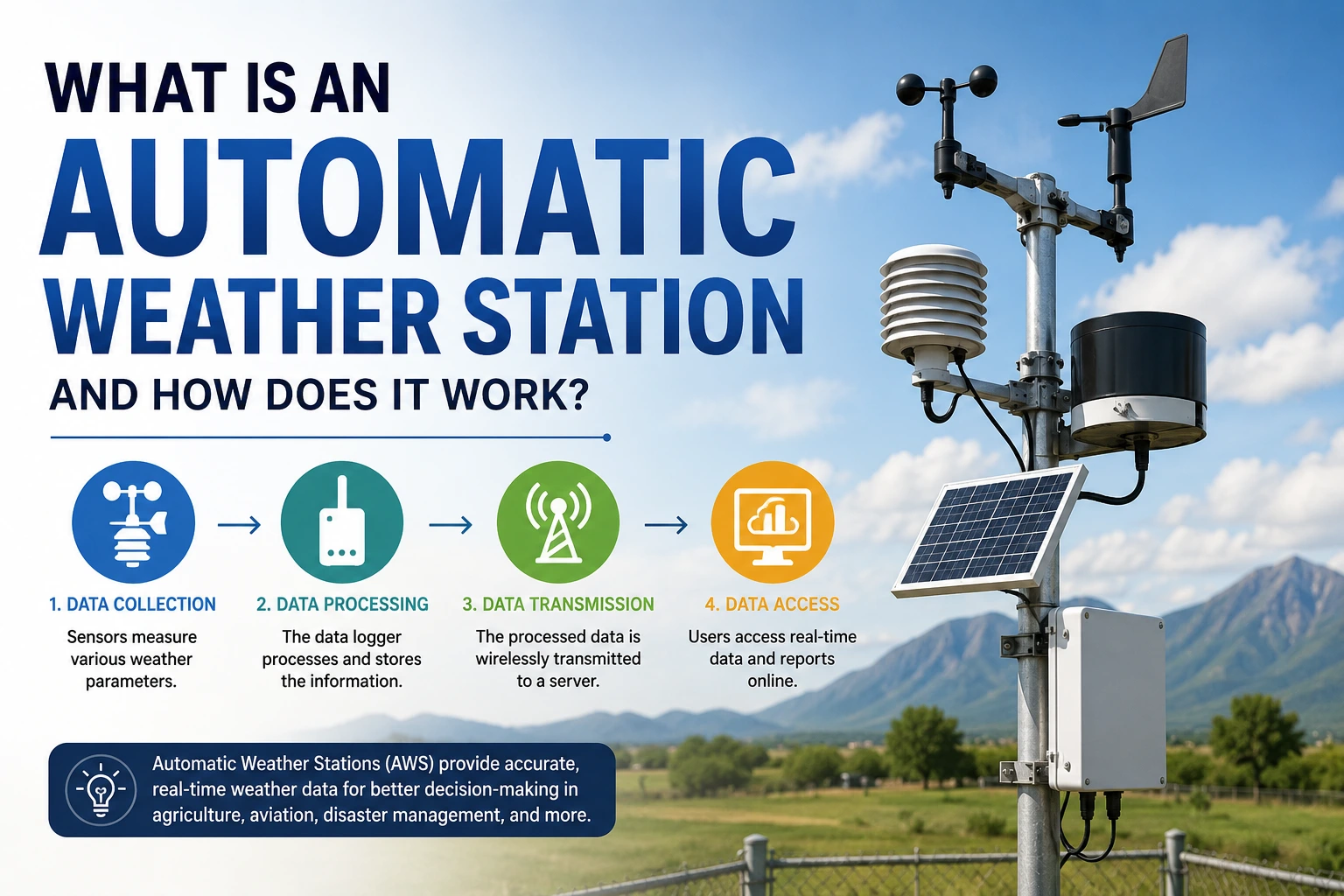
What is an automatic weather station?
An automatic weather station is a fully automated setup that generally gathers meteorological information with minimal or no human help.
It uses sensors and measures things like temperature, humidity, wind speed, rainfall, and even solar radiation. Then, it logs the readings and sends them for further analysis and forecasting.
Compared to older manual systems, AWS offers real-time data and delivers reliable weather updates.
Why is an automatic weather station important?
An automatic weather station uses sensors and gathers information continuously. This helps you make better decisions with clarity. Here are the reasons why an automatic weather station is important:
-
AWS supports more accurate forecasting.
-
It keeps checking the weather conditions, such as air temperature and rainfall totals.
-
Using AWS helps you fine-tune the solar facility's performance.
-
AWS helps protect the workers and equipment in harsh conditions.
-
Farmers use AWS for better irrigation timing and crop management.
How does an Automatic Weather Station work?
Here is the working of the AWS system:
-
The AWS sensors measure all weather data such as temperature, humidity, wind speed, precipitation, and solar radiation.
-
The system then logs and saves the data.
-
Using IoT, the system sends the data to cloud servers.
-
The staff in authority then check the data, analyses, and interpret it.
-
AWS pushes real-time alerts in case of any weather emergency.
Main parts of an Automatic Weather Station:
An AWS is not just one device. It’s more like several integrated pieces that cooperate so the results stay reliable. Here are the main parts of an automatic weather station:
|
Parts |
Function |
|
Weather monitoring sensors |
Observe environmental parameters |
|
Data logger |
Collects, saves, and forwards the readings. |
|
IoT communication system |
Provides cloud services and remote access |
|
Power Supply System |
Provides power to the whole system. |
Types of Weather Monitoring Sensors Used in AWS:
Here are the different types of weather monitoring sensors used in AWS:
-
Ambient Temperature Sensor:
To measure the surrounding air temperature for climate-style analysis.
-
Humidity Sensor:
Tracks moisture content in the air for studies and observations.
-
Wind Speed Sensor:
Wind speed sensor measures wind velocity, used both for forecasting and for industrial safety.
-
Wind Direction Sensor
Detects the direction of the wind for aviation and meteorological use.
-
Pyranometer / Solar Radiation Sensor:
Measures solar energy intensity to optimise the solar farm smartly.
-
Rain Gauge:
Records rainfall amounts and helps with agriculture and flood management.
Applications of Automatic Weather Stations:
Here are the applications of automatic weather stations:
|
Industries |
Application |
|
Solar Power Plants |
Checks solar irradiance and energy optimisation. |
|
Agriculture & Smart Farming |
Supports irrigation scheduling and crop cycle. |
|
Industrial Facilities |
Helps with safety planning and operational oversight. |
|
Environmental Monitoring |
Reads climate patterns and pollution. |
|
Research Centres |
Supports scientific weather studies and analysis. |
|
Airports & Infrastructure |
Ensures safer aviation activities and construction. |
|
Weather Forecasting |
gives real-time weather measurements |
Benefits of Weather Monitoring Systems Using IoT:
A weather monitoring system built with IoT increases accuracy, efficiency, and the ability to access the data whenever needed. Here are the benefits of a weather monitoring system using IoT:
-
AWS offers real-time monitoring and delivers quick weather updates, supporting decisions.
-
IoT allows you to access the weather data from anywhere.
-
AWS sends automated notifications during severe weather conditions.
-
AWS historical records help decide the upcoming weather conditions.
-
Accurate weather data optimises your operational planning.
-
Modern AWS uses automation so operators don’t need to do everything manually. This saves a lot of time.
Importance of Automatic Weather Stations in Solar Power Plants:
Here is how AWS optimises the solar power plants:
-
Solar irradiance monitoring:
Automatic weather stations measure the sunlight intensity, so energy estimation is more dependable.
-
Performance ratio calculations:
AWS checks how efficiently the solar plant is running
-
Weather impact analysis:
AWS examines how atmospheric changes affect energy delivery.
-
Energy optimization:
Automatic weather stations improve power generation efficiency, step by step.
-
SCADA integration:
AWS links with plant monitoring systems for automation.
How IoT Improve Weather Monitoring Systems?
Here are the ways in which IoT improves weather monitoring systems:
-
IoT systems offer a single cloud platform for data visualisation.
-
AWS allows checking conditions from phones and other devices.
-
IoT systems turn raw data into predictive insights.
-
They support oversight and adjustment from anywhere.
-
IoT systems strengthen industrial automation and coordination.
Factors to Consider When Choosing an Automatic Weather Station:
Here are the factors to consider when choosing an automatic weather station:
-
Check the sensor accuracy first.
-
Always buy durable units that can survive in harsh conditions.
-
Choose modern AWS systems with IoT setups and cloud connectivity.
-
IoT compatibility enables smart monitoring and easy integration.
-
It is ideally low maintenance, so long-term usage stays practical.
-
AWS supports advanced weather analysis, not just basic readings.
Why Choose LogicsPower Automatic Weather Stations?
LogicsPower offers you advanced automatic weather station solutions for your industrial and renewable energy use. We offer setups that mix high-precision sensors with IoT monitoring platforms, so you can see what’s happening in real time. We have designed the whole system to save time, effort, and optimise performance.
See the specialities of LogicsPower Automatic Weather stations:
-
Industrial-grade weather monitoring sensors
-
IoT-enabled cloud monitoring platform
-
Real-time analytics, plus reporting
-
Solar plant integration support
-
Reliable remote monitoring solutions
Conclusion:
Automatic weather stations are essential because they use crucial instruments for observing the environment. The whole system offers up-to-the-minute information that helps make better choices, and with IoT, it offers cloud access from anywhere in the world.
Since the need for renewable energy and smart infrastructure is rising, there is a growing demand for AWS monitoring systems with IoT. AWS technology plays a big part in strengthening safety, raising efficiency, and improving sustainability across many industries
FAQs:
-
What is an automatic weather station?
An automatic weather station is a system that gathers weather data automatically through sensors, with no need for people to manually collect it.
-
How does an automatic weather station work?
It uses sensors, data loggers, and IoT systems to gather and then forward real-time weather measurements.
-
What weather monitoring sensors are used in AWS?
Temperature sensors, humidity sensors, wind speed, wind direction, rainfall, and solar radiation sensors are typically used.
-
What are the benefits of weather monitoring systems using IoT?
You get real-time watching, remote access, automated warnings, and a kind of predictive interpretation.
-
Where are automatic weather stations used?
They show up in agriculture, solar facilities, industrial sites, airports, and research centres, too.
-
Can automatic weather stations integrate with solar SCADA systems?
Yes, AWS can integrate with SCADA systems for real-time solar plant monitoring.
-
What parameters can an automatic weather station monitor?
It can monitor temperature, humidity, rainfall, wind speed, wind direction, and solar radiation.