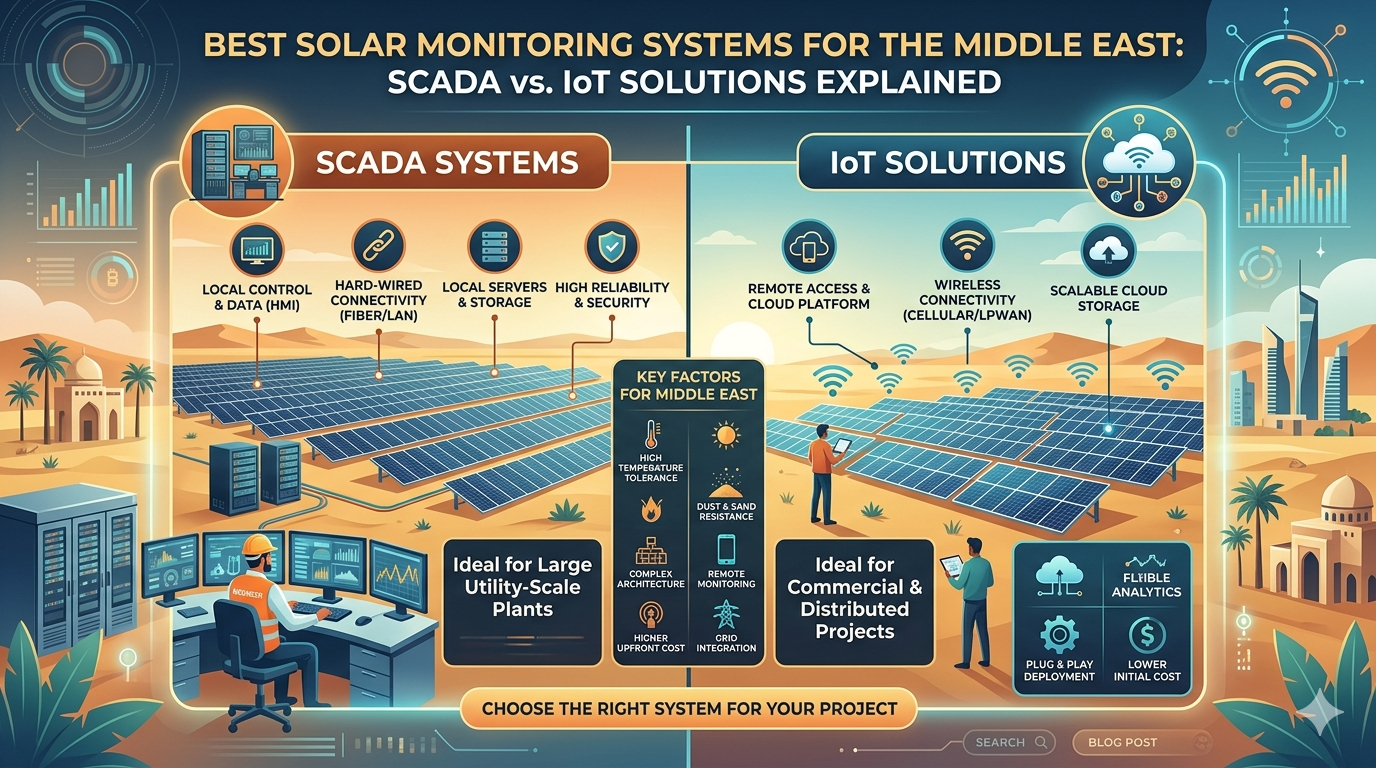
The Middle East is rapidly becoming a global leader in solar energy, with countries like the UAE, Saudi Arabia, and Bahrain investing heavily in large-scale solar projects. However, the region’s extreme climate, high temperatures, dust storms, and remote installations make efficient solar monitoring not just beneficial, but essential.
Choosing the right solar monitoring system can significantly impact plant performance, maintenance costs, and overall return on investment (ROI). In this guide, we compare SCADA vs IoT-based solar monitoring systems to help you select the best solution for your project in the Middle East.
Why Solar Monitoring is Critical in the Middle East
Solar plants in the Middle East operate under some of the harshest environmental conditions in the world. Without proper monitoring:
- Energy losses can go unnoticed
- Equipment failures may remain undetected
- Performance ratio (PR) drops significantly
- Maintenance becomes reactive instead of proactive
A robust monitoring system ensures:
- Real-time performance tracking
- Faster fault detection
- Optimized energy generation
- Reduced downtime
What is a Solar Monitoring System?
A solar monitoring system collects, analyzes, and displays data from solar PV plants. It enables operators to track key metrics such as:
- Energy generation
- Irradiance levels
- Inverter performance
- Temperature variations
These insights help optimize plant efficiency and ensure consistent energy output.
Types of Solar Monitoring Systems
1. SCADA-Based Solar Monitoring Systems
SCADA (Supervisory Control and Data Acquisition) systems are widely used in large-scale solar plants.
Key Features:
- Centralized control system
- High data accuracy
- Advanced analytics and reporting
- Real-time control capabilities
Pros:
- Ideal for utility-scale projects
- High reliability
- Deep system control
Cons:
- Expensive setup
- Complex infrastructure
- Requires skilled operation
2. IoT-Based Solar Monitoring Systems
IoT-based systems use cloud platforms and smart devices to monitor solar plants remotely.
Key Features:
- Cloud-based dashboards
- Remote monitoring via web/app
- Easy scalability
- Real-time alerts
Pros:
- Cost-effective
- Easy to deploy
- Ideal for distributed solar systems
Cons:
- Limited control compared to SCADA
- Dependent on internet connectivity
SCADA vs IoT: Detailed Comparison
| Feature | SCADA | IoT-Based Monitoring |
|---|---|---|
| Best For | Utility-scale plants | Commercial & distributed systems |
| Cost | High | Moderate |
| Scalability | Limited | High |
| Installation | Complex | Easy |
| Remote Access | Limited | Strong |
| Data Analytics | Advanced | Good |
Want to see how the right monitoring system can improve your solar performance? Explore how Logics Power delivers smart SCADA and IoT solutions tailored for challenging environments.
Best Solar Monitoring System Based on Use Case
Utility-Scale Solar Plants
- Recommended: SCADA
- Reason: Centralized control + large data handling
Commercial & Industrial Projects
- Recommended: IoT-based systems
- Reason: Cost-effective + remote access
Hybrid Solar Installations
- Recommended: SCADA + IoT integration
- Reason: Best of both worlds
Key Features to Look for in the Middle East
- When selecting a solar monitoring system, ensure it offers:
- High-temperature resistance
- Dust-proof sensors
- Remote monitoring capabilities
- Real-time fault alerts
- Advanced analytics dashboard
- These features are crucial for maintaining performance in desert environments.
Challenges in the Middle East & How Monitoring Helps
1. Dust & Sandstorms
- Reduce panel efficiency
- Monitoring helps detect performance drops instantly
2. High Temperatures
- Affects inverter and module performance
- Sensors help track temperature impact
3. Remote Locations
- Limited physical access
- IoT enables full remote control
How to Choose the Right Solar Monitoring System
Consider the following before making a decision:
Plant Size
- Large → SCADA
- Small/medium → IoT
Budget
- Limited budget → IoT
- High investment → SCADA
Connectivity
- Remote areas → IoT with strong network support
Why Logics Power is a Reliable Choice for Solar Monitoring
Logics Power offers advanced solar monitoring solutions tailored for challenging environments like the Middle East.
With a combination of:
- SCADA-based systems for large projects
- IoT-enabled monitoring for flexibility
- High-precision sensors
- Customizable dashboards
Businesses can ensure maximum efficiency and long-term performance of their solar assets.
FAQs
1. Which is better: SCADA or IoT for solar monitoring?
It depends on the project size. SCADA is ideal for large-scale plants, while IoT is better for distributed systems.
2. What is the cost of a solar monitoring system in the Middle East?
Costs vary based on system type, plant size, and features. IoT systems are generally more affordable than SCADA.
3. Can IoT replace SCADA completely?
Not entirely. IoT is great for monitoring, but SCADA offers deeper control for utility-scale plants.
4. Is remote monitoring necessary for solar plants?
Yes, especially in remote areas. It helps reduce downtime and improve operational efficiency.
Conclusion
Selecting the right solar monitoring system is crucial for maximizing performance in the Middle East’s demanding conditions. While SCADA systems provide robust control for large-scale operations, IoT-based solutions offer flexibility and cost efficiency for modern solar projects. By understanding your plant’s needs and environmental challenges, you can choose a solution that ensures optimal performance and long-term ROI.
Ready to choose the right solar monitoring system for your project? Connect with Logics Power to find a solution that maximizes efficiency, reduces downtime, and boosts your ROI.