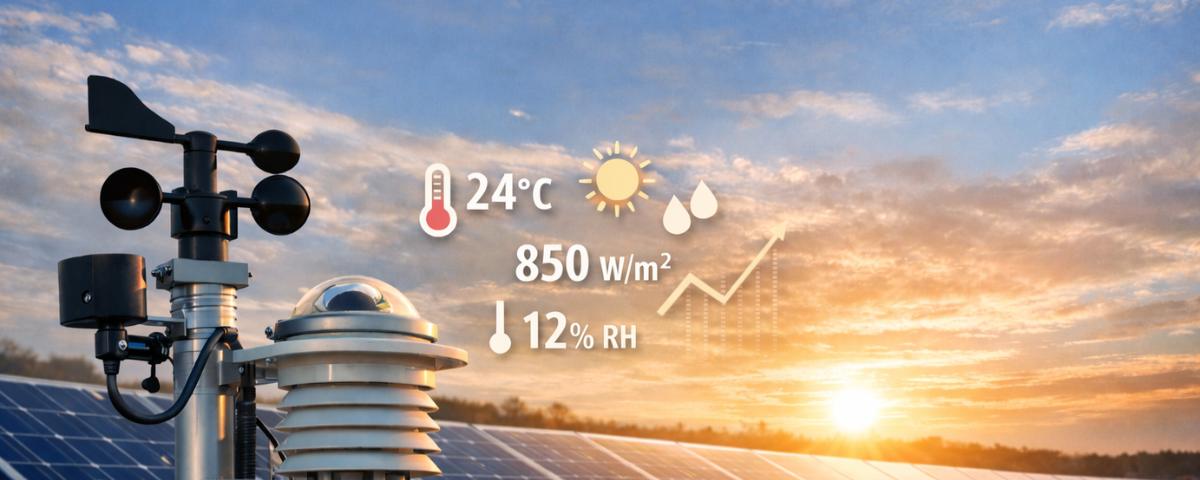
Weather Monitoring Sensors for Solar Plants: Why Accurate Data Matters
As solar power plants grow in size and complexity, accurate weather data has become one of the most critical factors in ensuring high energy yield, system reliability, and long-term profitability. Weather monitoring sensors play a vital role in tracking environmental conditions that directly affect solar plant performance.
In this blog, we explore what weather monitoring sensors are, why precise data is essential, and how they help solar plants operate at peak efficiency.
What Are Weather Monitoring Sensors in Solar Plants?
Weather monitoring sensors are specialized instruments installed at solar power plants to measure real-time meteorological parameters. These sensors collect data that helps operators understand how environmental conditions impact solar generation.
They are usually integrated with:
-
SCADA systems
-
Data loggers
-
Remote monitoring platforms
This data enables informed decisions for performance optimization and fault detection.
Key Weather Parameters That Affect Solar Power Generation
Accurate measurement of the following parameters is essential for solar plant efficiency:
1. Solar Irradiance
-
Measured using pyranometers or reference cells
-
Determines the actual solar energy available for generation
-
Essential for performance ratio (PR) calculation
2. Ambient Temperature
-
High temperatures reduce panel efficiency
-
Helps in analyzing thermal losses and module degradation
3. Module Temperature
-
Directly affects output voltage and power
-
Used to calculate temperature-corrected energy yield
4. Wind Speed and Direction
-
Affects module cooling and structural safety
-
Critical for tracker systems and extreme weather alerts
5. Relative Humidity
-
High humidity increases corrosion risk
-
Important for plants in coastal or high-moisture regions
6. Rainfall
-
Helps evaluate natural cleaning benefits
-
Useful for planning panel cleaning schedules
Why Accurate Weather Data Matters for Solar Plants
1. Precise Performance Analysis
Accurate weather data allows operators to compare actual generation vs. expected generation. Without reliable data, performance losses may go unnoticed or be misdiagnosed.
2. Improved Energy Yield Forecasting
High-quality weather data improves:
-
Day-ahead energy forecasting
-
Grid compliance
-
Power trading decisions
3. Early Fault Detection
When generation drops despite normal weather conditions, it indicates:
-
Inverter issues
-
Soiling losses
-
Module or string failures
Accurate data helps identify these problems early.
4. Better O&M Decision Making
Weather insights help optimize:
-
Panel cleaning frequency
-
Preventive maintenance schedules
-
Spare parts planning
This reduces downtime and operational costs.
5. Accurate Performance Ratio (PR) Calculation
PR is a key metric for solar plant health. Incorrect irradiance or temperature data leads to false PR values, impacting contractual and financial reporting.
6. Protection Against Extreme Weather
Real-time monitoring enables alerts for:
-
High wind speeds
-
Storms and cyclones
-
Heat waves
This allows operators to take preventive actions and protect assets.
Types of Weather Monitoring Sensors Used in Solar Plants
| Sensor Type | Purpose |
|---|---|
| Pyranometer | Measures global solar irradiance |
| Reference Cell | PV-based irradiance measurement |
| Ambient Temperature Sensor | Measures surrounding air temperature |
| Module Temperature Sensor | Tracks panel surface temperature |
| Wind Speed Sensor (Anemometer) | Measures wind velocity |
| Wind Direction Sensor | Indicates wind direction |
| Humidity Sensor | Measures moisture levels |
| Rain Gauge | Records rainfall amount |
Best Practices for Installing Weather Sensors
-
Install sensors at representative locations
-
Use calibrated and IEC-compliant instruments
-
Perform regular cleaning and recalibration
-
Avoid shading and reflective surfaces
-
Integrate sensors with centralized monitoring software
Future of Weather Monitoring in Solar Plants
With advancements in IoT, AI, and predictive analytics, weather monitoring is evolving rapidly. Modern systems now offer:
-
Cloud-based data access
-
AI-driven performance insights
-
Predictive maintenance alerts
-
Higher accuracy with minimal manual intervention
These innovations help solar plants maximize output while minimizing risks.
Conclusion
Weather monitoring sensors are no longer optional—they are essential for maximizing energy production, ensuring system reliability, and achieving financial accuracy in solar power plants. Accurate weather data empowers plant operators to make smarter decisions, reduce losses, and extend asset life.
Investing in high-quality weather monitoring solutions today ensures higher returns and sustainable solar operations tomorrow.